In a world full of noise, the ability to focus deeply is what sets high performers apart today

In a world of open offices, constant notifications, and back-to-back meetings, the ability to focus deeply has quietly become one of the most valuable skills you can build. Not because work has become harder but because distraction has become the default.
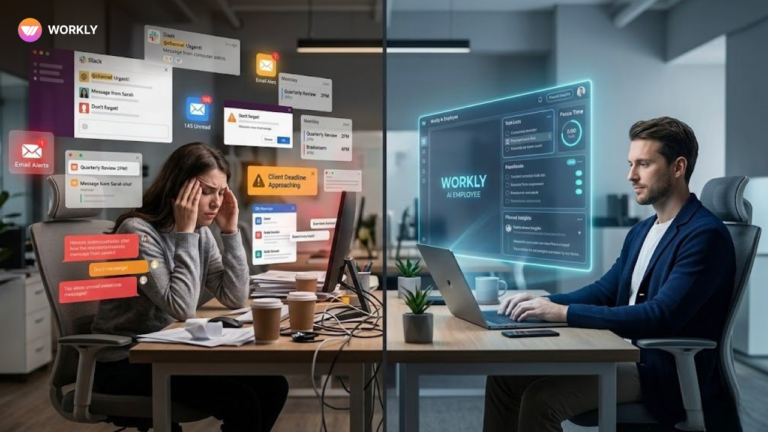
Every ping pulls you away. Every “quick check” breaks momentum. Every meeting fragments your thinking.
And the real cost isn’t just time, it’s the quality of your output.
Cal Newport popularized the concept of deep work, but today, it’s no longer just a productivity philosophy. It’s a survival skill. Because as work becomes more automated, the only thing that truly differentiates you is your ability to think clearly, solve complex problems, and create meaningful output.
But here’s the problem: most modern workflows are fundamentally designed against deep work.
And that’s exactly where tools like Workly and its AI employee begin to change the equation.
Distraction is easy. Depth is rare. That’s why it wins
What Deep Work Really Means (And Why It’s So Rare)
Deep work isn’t just “working without distractions.” It’s a state of intense cognitive focus where you’re fully immersed in a task that pushes your abilities to their limit.
It’s when:
- You’re building strategy, not just executing tasks
- You’re creating, not just responding
- You’re solving problems that actually move things forward
This kind of work is hard. It requires sustained attention, mental clarity, and uninterrupted time all things that are increasingly rare in today’s work environment.
Most people don’t lack capability. They lack conditions.
Because when your day is filled with emails, Slack messages, follow-ups, and status updates, your brain never gets the uninterrupted stretch it needs to enter deep focus.
What you end up doing instead is shallow work tasks that keep you busy but don’t create real impact.
The Neuroscience Behind Focus (Why Distraction Is So Expensive)
When you enter a state of deep work, your brain begins strengthening neural pathways through a process called myelination. Simply put, the more you focus deeply on something, the more efficient your brain becomes at doing it.
This is how expertise is built not through repetition alone, but through undistracted, high-quality attention.
Now flip that.
Every time you get interrupted:
- Your attention fragments
- Your brain switches context
- Your cognitive load increases
And here’s the part most people underestimate research shows it takes over 20 minutes to fully regain focus after a single interruption.
So if your day includes 10–15 interruptions (which is normal), you’re not just losing minutes you’re losing the ability to ever reach deep work at all.
This is why you can feel exhausted at the end of the day without having done anything meaningful. Your brain has been active but not effective.
The Hidden Trap: Why Shallow Work Feels Productive
Shallow work is seductive because it gives immediate feedback.
You reply to an email — done.
You attend a meeting — done.
You clear notifications — done.
It feels like progress.
But most of this work doesn’t compound. It doesn’t create long-term value. It just keeps the system running.
The real problem isn’t that shallow work exists it’s that it dominates your day.
And this is where most professionals get stuck. They try to “protect focus” manually, but the system around them keeps pulling them back into reactive mode.
This is exactly where Workly’s AI employee becomes critical.
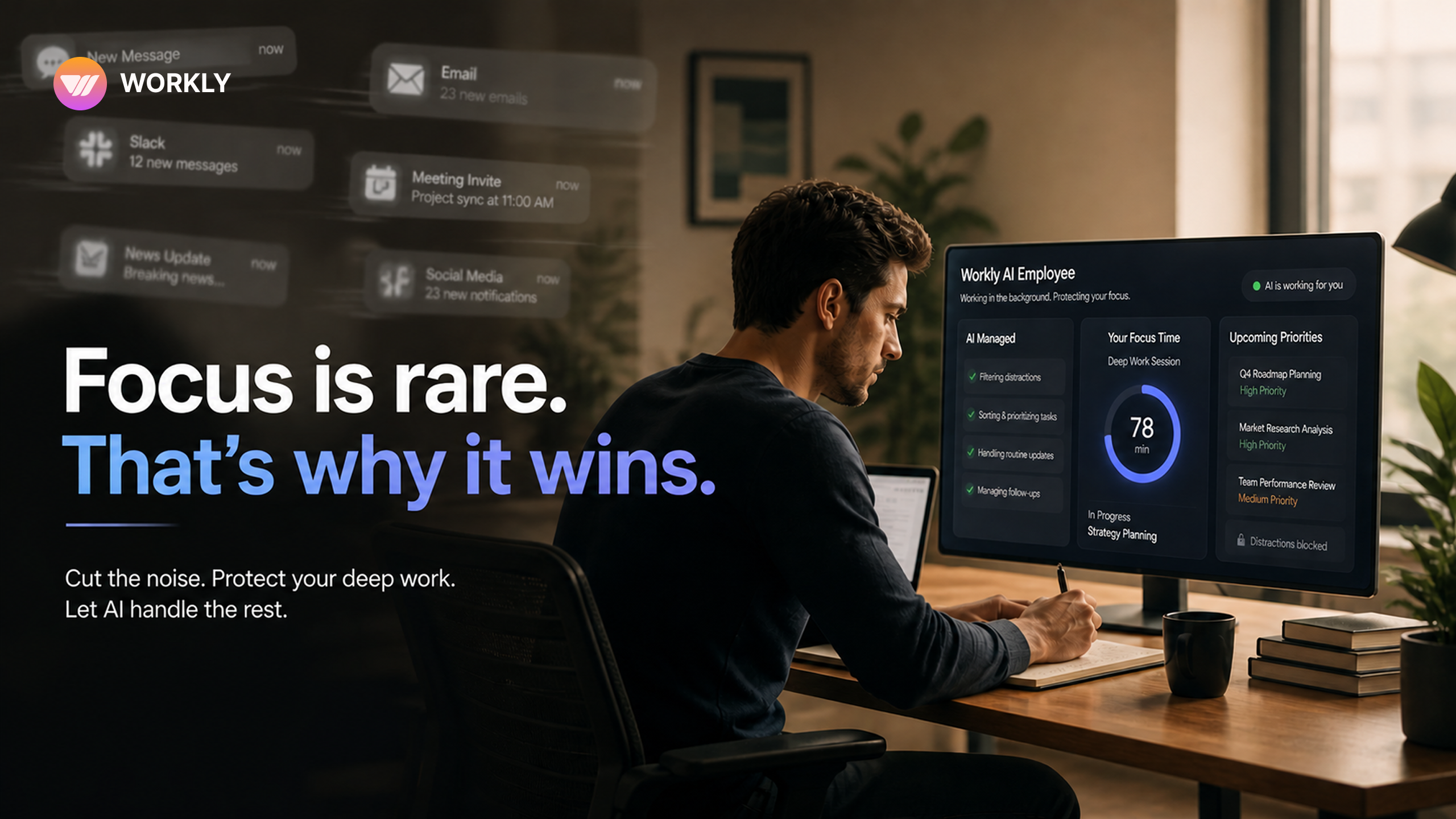
Instead of you fighting distractions all day, the AI employee:
- Filters incoming tasks
- Converts noise into structured workflows
- Handles routine coordination
- Reduces unnecessary interruptions
So your environment finally supports deep work instead of constantly breaking it.
Why Deep Work Is Becoming a Competitive Advantage
As AI continues to automate repetitive and operational tasks, the value of human work is shifting.
Execution is getting faster. Coordination is getting automated. Routine work is getting handled.
What remains valuable?
The ability to:
- Think deeply
- Solve non-obvious problems
- Create high-quality output
- Make strategic decisions
In other words, deep work.
The professionals who will stand out are not the busiest ones they are the ones who can sit with a problem longer, think more clearly, and produce better outcomes.
But this only happens if their time and attention are protected.
And protecting that manually is becoming nearly impossible.
How an AI Employee Helps You Protect Deep Work (Without Fighting Your Workflow)
Most advice around deep work focuses on discipline wake up early, turn off notifications, block your calendar.
That works in theory.
But in reality, work keeps coming.
Messages don’t stop. Tasks keep piling up. People still need updates.
This is where an AI employee changes things fundamentally.
Instead of relying on willpower, it restructures your workflow itself.
It captures incoming tasks from different channels and organizes them into clear priorities, so you’re not constantly checking multiple platforms. It handles task assignment and follow-ups automatically, so you don’t get pulled into coordination loops. It reduces unnecessary back-and-forth by structuring communication into actionable outputs.
Most importantly, it protects your focus by ensuring that only high-priority work reaches your attention during your deep work windows.
So instead of constantly defending your time, your system does it for you.
Practical Ways to Actually Protect Deep Work (That Work in Real Life)
Deep work doesn’t happen by accident it has to be designed into your day.
Start by scheduling dedicated focus blocks, even if it’s just 60–90 minutes. Treat this time as non-negotiable. The difference between intention and execution is scheduling.
Create a shutdown ritual at the end of your day. Close open loops, review tasks, and define your priorities for tomorrow. This allows your brain to disengage fully and return with clarity.
Reduce digital distractions aggressively. Notifications are not neutral they are interruptions. Turning them off is not extreme, it’s necessary.
Work in cycles that match your energy. Your brain isn’t built for constant output. Focus deeply, then rest intentionally.
And most importantly, guard your peak cognitive hours usually your mornings. Don’t spend them reacting. Spend them creating.
Now layer AI into this.
With Workly’s AI employee:
- Your tasks are already structured before your day starts
- Your priorities are clear without manual sorting
- Your interruptions are minimized at the system level
So these habits become easier to maintain, not harder.
Final Thought
The ability to focus is becoming rare. And because it’s rare, it’s becoming valuable.
In a world where everything is designed to distract you, protecting your attention is no longer optional it’s a competitive advantage.
Deep work isn’t just about productivity.
It’s about clarity.
It’s about quality.
It’s about doing work that actually matters.
And the question is no longer just: Can you focus?
It’s:
Do you have a system that allows you to?
Because when you combine deep work with the support of an AI employee like Workly, something powerful happens.
You don’t just get more done.
You start doing the kind of work that actually moves everything forward.
FAQ’S
What is deep work and why is it important?
Deep work is the ability to focus without distraction on cognitively demanding tasks. It’s important because it leads to higher-quality output, faster skill development, and meaningful progress—something shallow, reactive work rarely delivers.
Why is it so hard to focus in today’s work environment?
Modern workplaces are filled with constant interruptions—notifications, meetings, and messages—which fragment attention. This prevents your brain from entering a state of deep focus, making sustained concentration difficult.
How do distractions impact productivity and brain performance?
It ensures work continues without waiting for meetings or real-time responses, increasing speed and consistency.
How can an AI employee help protect deep work time?
An AI employee filters incoming tasks, manages routine coordination, and reduces unnecessary interruptions. This allows you to work in longer, uninterrupted focus blocks without constantly reacting to new inputs.
What are simple ways to start building a deep work habit?
Begin by scheduling dedicated focus time, minimizing notifications, and identifying your most important task for the day. Even 60–90 minutes of uninterrupted work daily can significantly improve output and clarity.
AI-First Collaborative OS
Stop managing tools. Start running work.


Emily Carter
Technical writer specializing in SaaS product documentation and in-app guides. Converts engineer-heavy inputs into clear user journeys, FAQs, and release notes.