Marketing teams today are not struggling because they lack ideas, creativity, or planning frameworks. In most cases, campaigns are thoughtfully designed, messaging is aligned, and timelines are clearly defined. On the surface, everything appears to be in place for a successful launch. However, despite this level of preparation, campaigns often fail to launch on time. The …

Marketing teams today are not struggling because they lack ideas, creativity, or planning frameworks. In most cases, campaigns are thoughtfully designed, messaging is aligned, and timelines are clearly defined. On the surface, everything appears to be in place for a successful launch.
However, despite this level of preparation, campaigns often fail to launch on time.
The delay does not come from strategy but from execution.
A content piece may be waiting for approval, a dependency might not be resolved, or a small but critical task could be overlooked. These small gaps accumulate, leading to missed deadlines and slower campaign rollouts.
The issue is not capability. It is the breakdown in execution.
The Real Problem Is Not Planning, It Is Movement
Modern marketing teams have access to structured workflows, content calendars, and well-defined processes. Work is organized, tasks are assigned, and responsibilities are clear. Yet, organization alone does not ensure progress.
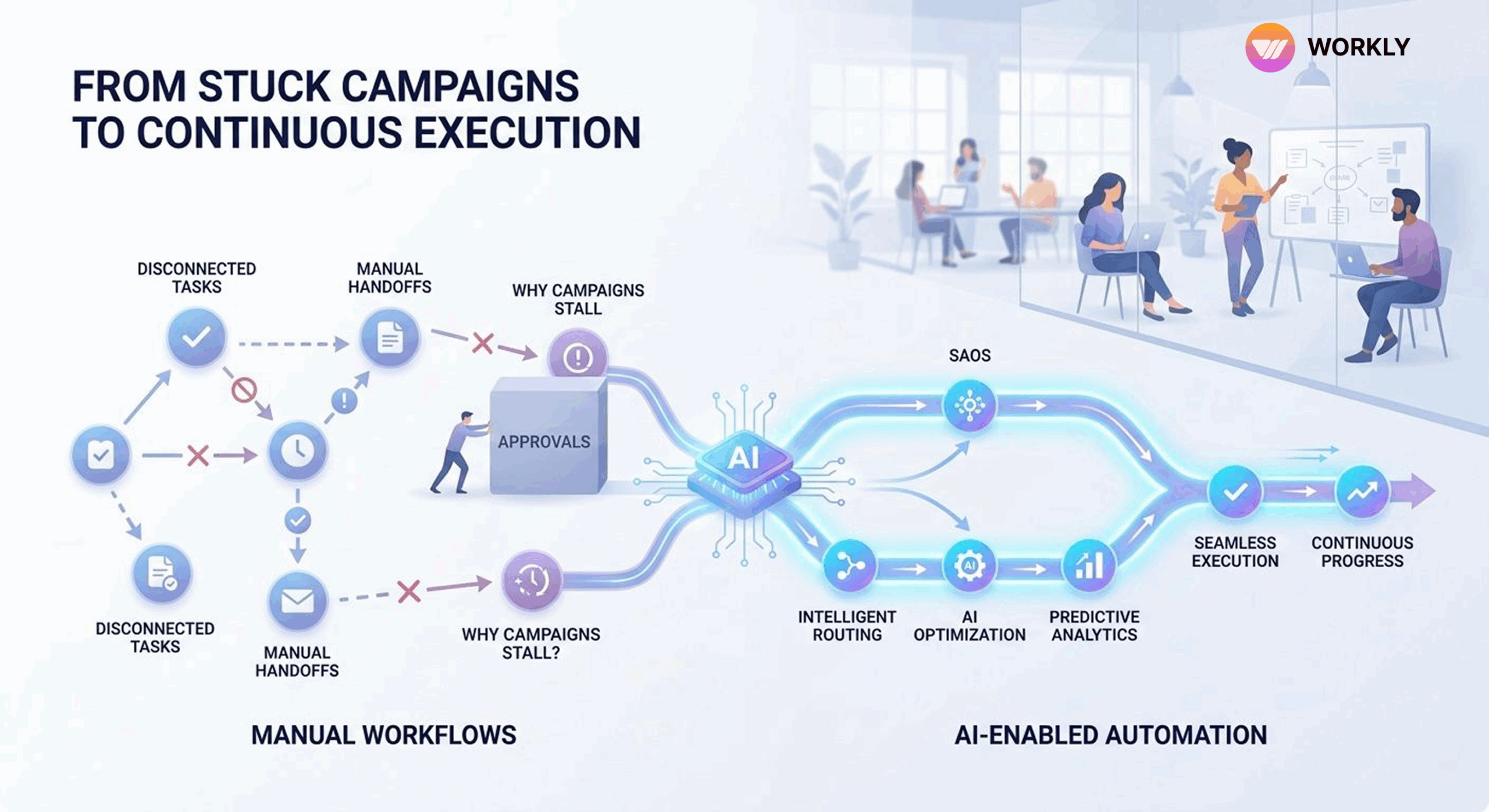
For work to move forward, every task requires coordination, updates, and continuous attention. Teams must follow up, check statuses, and ensure that dependencies are resolved on time. This creates an environment where progress depends heavily on manual intervention.
As a result, campaigns slow down not because they are poorly planned, but because the movement between tasks is not seamless. The gap between one step and the next becomes the primary source of delay.
What Marketing Teams Actually Need is WORKLY
Marketing is no longer just about generating ideas or building campaigns. It is about executing those campaigns efficiently and consistently. A campaign is not a single activity but a sequence of interconnected steps that must move together.
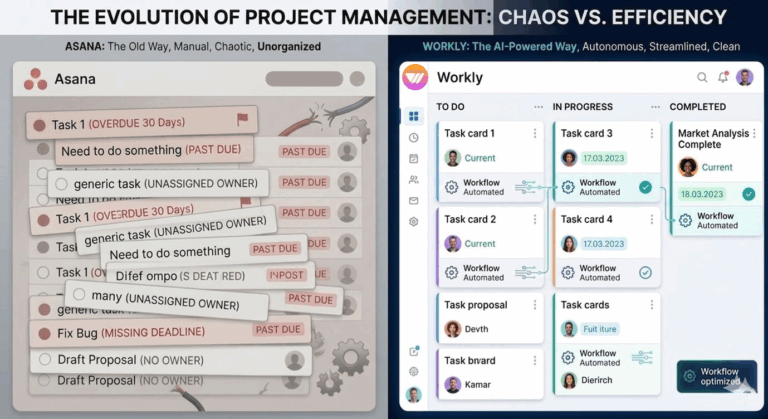
Workly is built to remove that friction. Instead of relying on constant follow-ups and manual coordination, it enables workflows that are designed to move continuously. Tasks do not sit waiting for the next action. They progress with clarity, alignment, and minimal intervention.
For marketing teams, this changes the way campaigns are executed. Workly reduces the operational drag behind every stage, allowing teams to focus on outcomes rather than managing movement. The result is not just better organization, but faster execution, stronger consistency, and campaigns that actually launch when they are supposed to.
AI Employees Introduce a New Execution Layer
AI in marketing has traditionally focused on assisting tasks such as content creation, idea generation, and data analysis. While these capabilities improve productivity, they do not address the core issue of execution.
AI employees represent a different approach. Instead of only assisting with individual tasks, they are designed to support workflow progression. Their role is to reduce the dependency on manual coordination and help maintain continuity across processes.
By operating within workflows, AI employees help ensure that tasks do not remain static and that work continues to move forward with less intervention.
From Static Tasks to Continuous Workflow Movement
AI employees in Workly, this dynamic fundamentally changes. Work is no longer dependent on constant human intervention. AI employees operate within the workflow, understanding what needs to happen next and ensuring that execution does not stall. With just a brief input, they can help initiate campaigns, guide task progression, and keep every stage aligned without waiting for manual triggers.
AI Employee do not simply track work, they actively support its movement. If told the right actions at the right time, reduce the need for repeated follow-ups, and ensure that nothing sits idle longer than it should. Instead of teams pushing tasks forward, the system helps pull work through each stage.
This shift transforms execution from a reactive process into a continuous flow. Marketing teams experience fewer delays, smoother coordination, and a system where progress is not dependent on constant oversight but is built into how work happens.
How AI Employees Support Marketing Campaign Execution
AI employees play a critical role across different stages of a marketing campaign by ensuring that workflows remain active and connected.
- During campaign planning, they help structure workflows based on inputs, reducing the time required to set up processes. This allows teams to move from idea to execution more quickly.
- In content and creative workflows, they help ensure that tasks do not remain stuck between stages. Progress continues without unnecessary delays, and dependencies are handled more efficiently.
- During execution, the reliance on manual follow-ups is significantly reduced. Teams no longer need to constantly check the status of tasks, as workflows are designed to move with greater consistency.
- Coordination effort also decreases, as fewer manual interventions are required to keep work aligned. This results in smoother collaboration and less time spent on operational communication.
- As a result, campaign timelines become more predictable, enabling teams to plan and execute with greater confidence.
Workly’s GTM Templates Enable Faster Campaign Launches
A significant portion of delay in marketing campaigns occurs even before execution begins. Teams often spend considerable time setting up workflows, defining processes, and structuring tasks.
Workly addresses this challenge through pre-built go-to-market templates designed specifically for marketing teams. These templates provide a ready-made structure for campaign execution, allowing teams to start with a proven workflow instead of building from scratch.
By reducing setup time and standardizing processes, these templates enable faster campaign launches and more consistent execution. Teams can focus on strategy and outcomes rather than spending time on operational setup.
Execution Is the Real Growth Lever
Many teams attempt to improve performance by refining strategies, producing more content, or adopting additional tools. While these efforts are valuable, they often overlook the most critical factor: execution.
When execution improves, campaigns launch faster, iteration cycles become shorter, and opportunities are captured more effectively. This leads to better performance and more consistent results over time.
Execution is not just an operational concern. It is a key driver of growth.
The Shift Marketing Teams Need to Make
The way marketing teams operate is evolving. Traditional workflows rely heavily on planning, managing, and constant follow-ups to ensure progress.
The new approach focuses on enabling execution through systems that support workflow movement. Instead of relying entirely on manual effort, teams can leverage AI employees to reduce friction and maintain momentum.
This shift allows teams to move from managing work to completing it more efficiently.
Conclusion
Marketing campaigns rarely fail because of poor strategy. More often, they fail because execution slows down at critical points in the workflow.
AI employees address this challenge by supporting continuous workflow progression and reducing the need for manual coordination. By focusing on execution, they help teams move faster, maintain consistency, and achieve better outcomes.
Final Perspective
Effective marketing is no longer defined only by how well campaigns are planned. It is defined by how efficiently they are executed.
AI-First Collaborative OS
Stop managing tools. Start running work.


Emily Carter
Technical writer specializing in SaaS product documentation and in-app guides. Converts engineer-heavy inputs into clear user journeys, FAQs, and release notes.