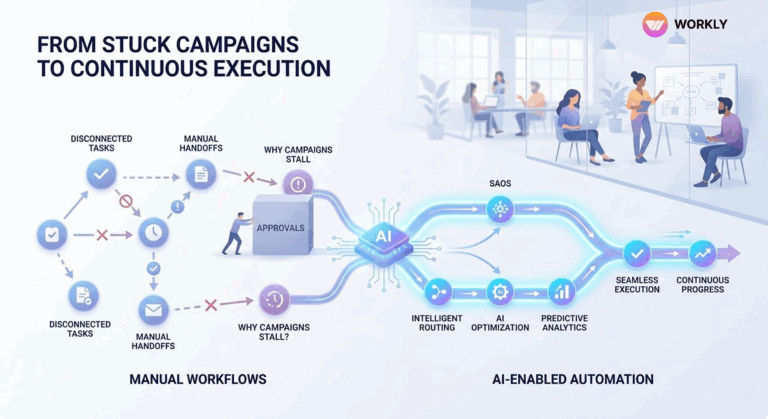
The problem is not a lack of tools, it is the overload of coordination. Asana helps teams stay organized, but Workly helps them move faster by turning conversations into action and minimizing manual follow-ups. It is the difference between tracking progress and driving it.

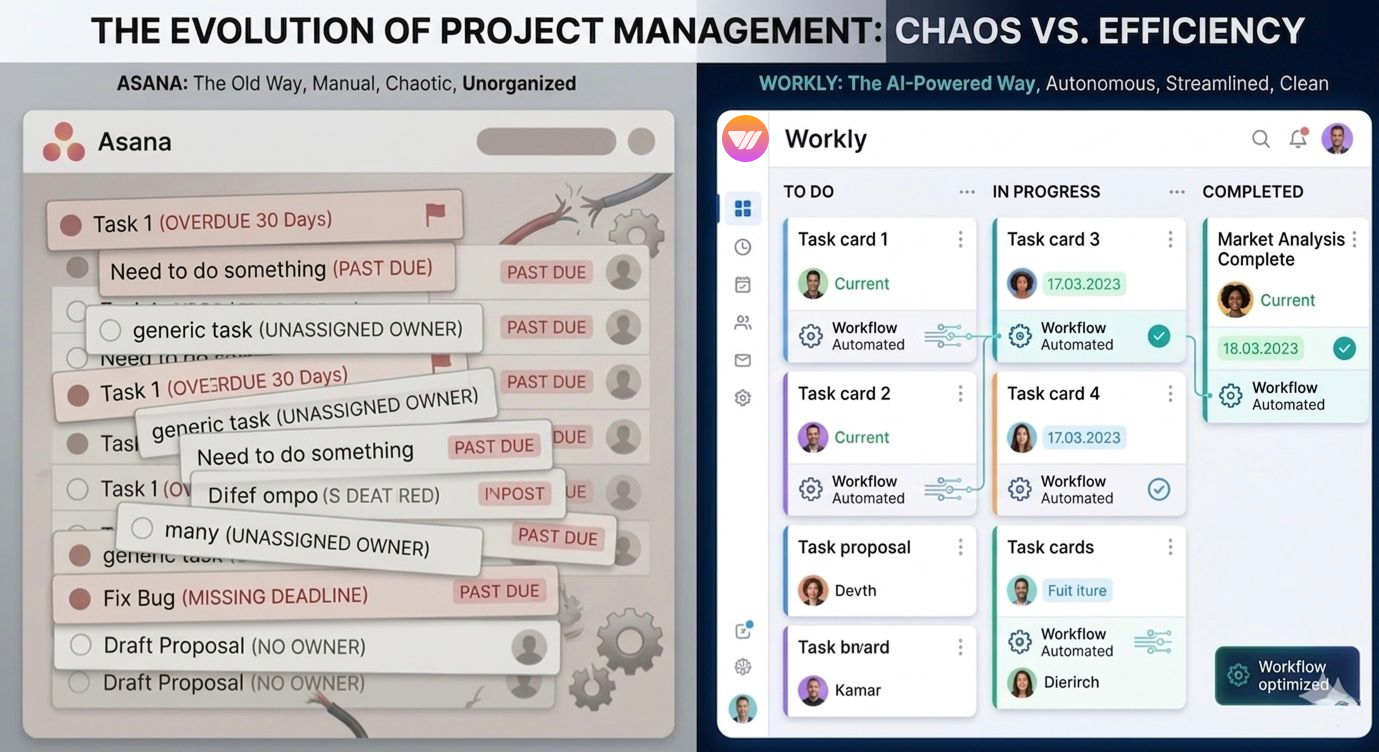
Project management tools have significantly improved how teams plan and organize their work. Platforms like Asana have set a high standard for clarity, structure, and collaboration.
Today, most teams no longer struggle with visibility. Tasks are clearly defined, responsibilities are assigned, and timelines are mapped.
Yet, a consistent challenge remains.
Asana helps you manage tasks. Workly helps you finish them.
Despite well-structured plans, execution often slows down. Tasks remain in progress longer than expected, dependencies introduce delays, and teams spend considerable time on follow-ups and coordination.
This highlights a growing gap between planning work and completing it efficiently.
Understanding Asana: Strengths in Planning and Organization
Asana is designed to bring structure and clarity to complex workflows. It enables teams to break projects into manageable tasks, assign clear ownership, define timelines and dependencies, and track progress through visual dashboards.
For teams focused on planning, alignment, and visibility, Asana remains a strong and dependable solution. It ensures that everyone understands what needs to be done and how work is structured across the organization.
Where Planning Tools Reach Their Limits
While Asana excels in organizing work, it operates primarily as a planning and tracking system.
In practice, this means that task progression depends on individuals taking action. Follow-ups are typically manual or based on predefined rules, and workflow movement requires continuous coordination. Even when everything is clearly defined, delays can still occur.
Over time, this creates an operational pattern where teams spend increasing effort on managing workflows rather than advancing them. The issue is not a lack of structure, but a lack of continuous execution support.
Extending Beyond Planning: The Role of Workly and AI Employees
Workly addresses this gap by focusing on what happens after planning is complete. Instead of replacing tools like Asana, Workly is designed to complement them by improving how work progresses.
At the core of this approach is the concept of AI employees. These are not just assistants that suggest actions, but systems designed to actively support execution within workflows. They help reduce manual effort by assisting in task creation from workflows and inputs, minimizing the need for constant follow-ups, and supporting the progression of tasks through automated or guided actions.
This introduces a new layer in work management where execution is not entirely dependent on human intervention. Instead of teams repeatedly coordinating small steps, AI employees help handle routine movement within workflows, allowing teams to focus on higher-value work.
The result is a shift from managing tasks to enabling smoother and more consistent task completion.
Comparative Overview
Capability | Workly | Asana |
Strong Project Planning | ❌ | ✔ |
Advanced Task Structuring | ❌ | ✔ |
Workflow Execution Support | ✔ | ❌ |
Reduced Manual Follow-ups | ✔ | ❌ |
AI-assisted Workflow Execution | ✔ | ❌ |
Rule-based Automation | ❌ | ✔ |
Where Asana May Fall Short for Certain Teams
It is important to note that Asana is not lacking in capability. Its design is intentionally centered on planning and coordination.
However, for teams experiencing frequent delays despite clear plans, a high dependency on manual follow-ups, increasing coordination overhead, or slower execution cycles, limitations begin to appear. These limitations are not related to planning itself, but to execution continuity.
Where Workly Adds Value
Workly is particularly relevant in environments where workflows involve multiple steps and dependencies, where teams experience execution bottlenecks, and where repetitive coordination consumes valuable time. It becomes especially useful when maintaining momentum across tasks is a challenge.
By focusing on reducing friction in execution, Workly helps teams move from structured plans to consistent outcomes. The introduction of AI employees further strengthens this by ensuring that routine workflow steps do not slow down overall progress.
When to Use Each Approach
Workly becomes a strong consideration when execution speed is a recurring challenge, when teams spend significant time on follow-ups, when workflow momentum is difficult to maintain, or when there is a clear need to reduce manual effort in task progression.
On the other hand, Asana remains highly effective when the primary requirement is structured planning, clear visibility, and straightforward workflow management without heavy execution complexity.
Conclusion: From Organized Work to Completed Work
Asana has successfully addressed the challenge of organizing and structuring work.
However, as team environments evolve, the focus is shifting toward how efficiently work gets completed.
Workly extends this capability by supporting execution, reducing manual effort, and helping workflows progress with greater consistency. Through the introduction of AI employees, it adds a new layer where work is not only planned but also actively supported as it moves forward.
The distinction is not about which tool is better, but about which part of the workflow each tool is designed to optimize.

Rachel Nguyen!
Technical writer with a UX writing edge for enterprise products. Builds onboarding, contextual help, and knowledge bases that cut support tickets.