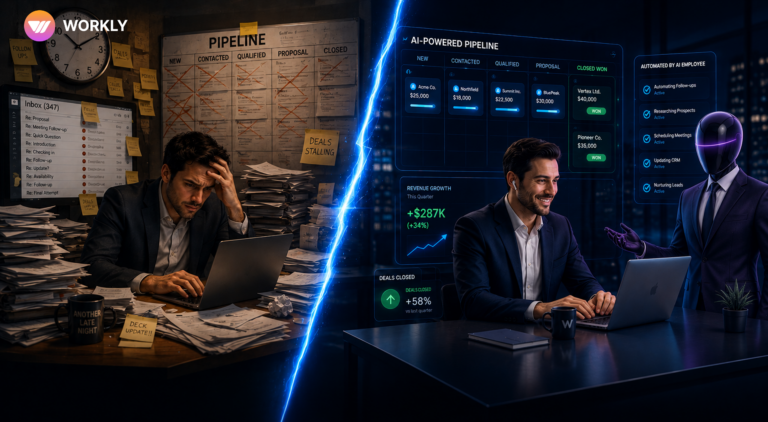
The smarter you use it, the smarter it gets. Welcome to the future of personalized AI at work.

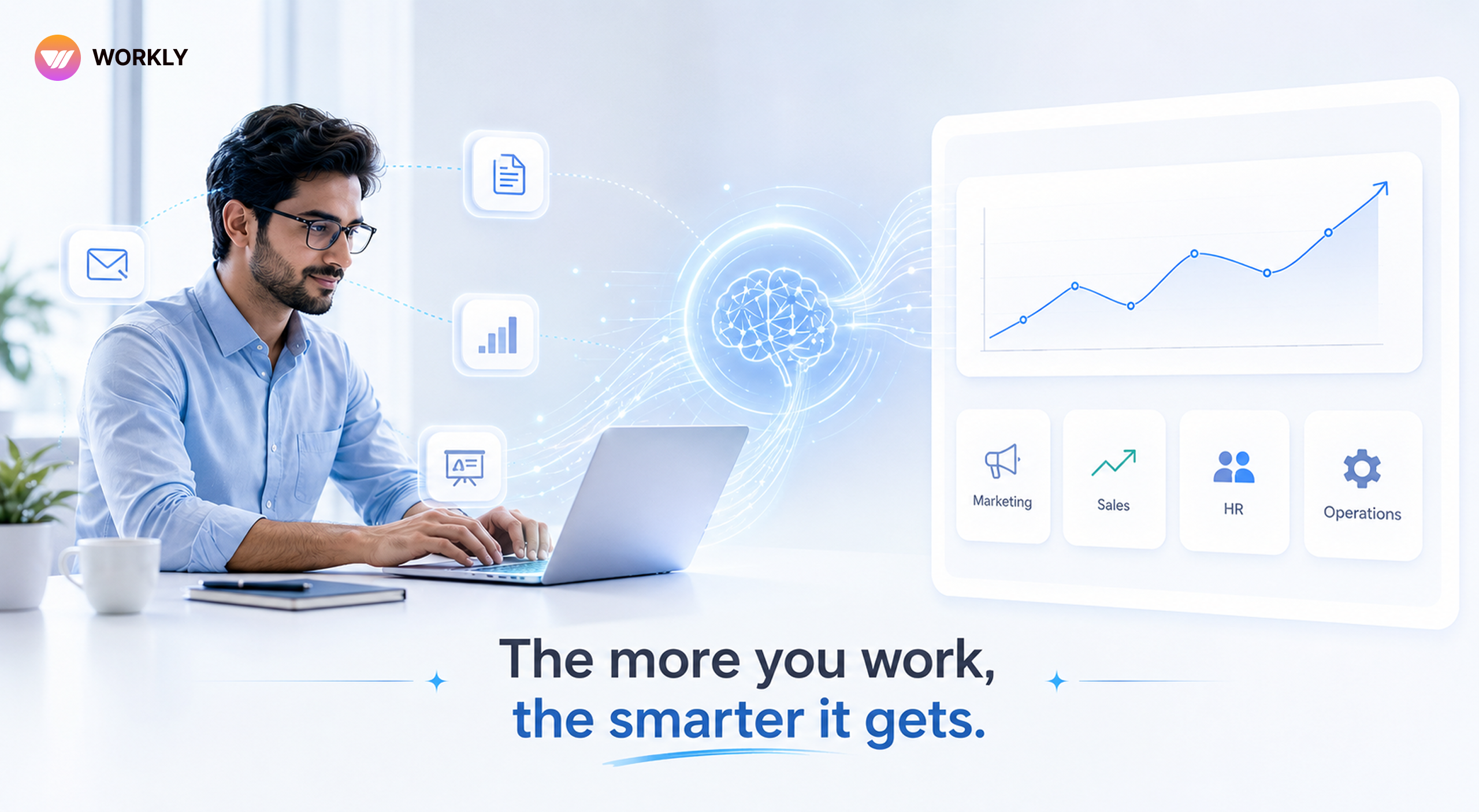
Most workplace tools treat every user the same. Same interface. Same features. Same experience. Whether you’re a first-year marketing intern or a senior operations director with 15 years of experience, traditional software doesn’t care. It gives you what it gives everyone else and calls it productivity.
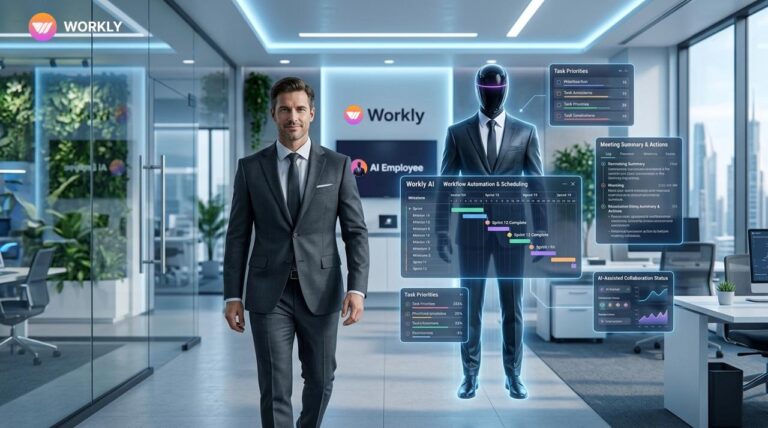
Workly’s AI Employee is built on a completely different philosophy. It doesn’t just execute tasks it observes, adapts, and evolves based on how you specifically work. Your habits, your tone, your priorities, your workflow patterns. Over time, it stops feeling like a tool and starts feeling like the most reliable colleague you’ve ever had. One that never forgets, never gets distracted, and gets sharper every single week.
This is not automation. This is adaptive intelligence at work.
What Does It Mean for an AI Employee to "Learn" You?
Before diving into departments and real examples, it’s important to understand what personalized AI actually means in a workplace context.
When most people hear “AI learns your style,” they imagine something vague and futuristic. In reality, it’s far more practical. Workly’s AI Employee pays attention to the specific decisions you make repeatedly. The way you structure your emails. The level of detail you prefer in reports. The tone you use when communicating with clients versus your internal team. The tasks you always prioritize on Monday mornings. The format you keep coming back to for presentations.
Every interaction you have with your AI Employee becomes a data point. Every edit you make, every task you approve, every piece of content you refine — the system is quietly building a picture of how you think and how you work. And it uses that picture to serve you better the next time. This is what separates a truly intelligent AI Employee from a basic automation tool. Basic tools follow instructions. Intelligent systems anticipate them.
How the Learning Process Actually Works
The personalization journey with Workly’s AI Employee happens in layers, and it begins from day one.
In the early stage, your AI Employee focuses on observation. It notices the type of tasks you assign most frequently. It picks up on the language patterns in your communications. It registers which outputs you approve without changes and which ones you modify. These early signals are the foundation of your personalized AI experience.
By the second and third week, patterns start forming. Your AI Employee begins predicting preferences. If you consistently shorten paragraphs in content drafts, it starts delivering tighter copy from the start. If you always add a summary section at the end of reports, it begins including one automatically. If you prefer direct, no-fluff communication in internal messages, that becomes the default tone.
Over time — weeks, months, ongoing use — the intelligence deepens. Your AI Employee doesn’t just remember your preferences; it understands the reasoning behind them. It connects context with behavior. It knows that your Friday updates need to be short and visual because your team is wrapping up the week. It knows your client-facing content needs to be formal but warm because that’s the relationship you’ve built. This is personalization at a level no static tool can deliver.
Marketing Teams: Content That Already Knows Your Voice
For marketing professionals, brand voice is everything. Inconsistent tone across campaigns, social posts, and emails creates confusion and weakens brand identity. Training new team members or freelancers to match the brand voice takes weeks and still produces inconsistent results.
With an AI Employee that learns your style, that problem disappears. After observing your content patterns, it understands exactly how your brand sounds. Punchy and witty for social media. Informative and authoritative for long-form articles. Warm and conversational for email newsletters. The AI Employee doesn’t need a style guide every time — it has internalized yours. Marketers using Workly report spending significantly less time on revisions and more time on strategy, campaign planning, and creative direction. The AI handles execution. The human handles vision. That’s the combination that produces exceptional marketing output consistently.
Sales Teams: Personalized Pitches Without the Prep Time
Sales is one of the most time-sensitive departments in any organization. Every hour spent on internal prep is an hour not spent with prospects. Yet creating personalized outreach, tailored proposals, and follow-up communications still consumes enormous time for most sales professionals.
Workly’s AI Employee changes this equation entirely. As it learns a salesperson’s communication approach — the way they open conversations, how they handle objections in writing, the level of urgency they build into follow-ups — it starts producing first drafts that require minimal editing. It learns which industries each salesperson targets most and adjusts the language accordingly. It picks up on the specific value propositions each rep emphasizes and leads with those automatically. The result is faster pipeline movement, more consistent outreach quality, and sales professionals who spend their energy closing deals rather than writing emails.
HR Departments: Communication That Feels Human at Scale
Human Resources handles some of the most sensitive communication in any organization — from hiring and onboarding to performance conversations and policy updates. Getting the tone wrong in HR communication can damage trust, create confusion, and affect employee morale.
An AI Employee that has learned an HR team’s communication style becomes an invaluable partner. It understands when to use empathetic, supportive language and when to be clear and direct. It learns the specific structure your team uses for offer letters, feedback summaries, and policy announcements. It picks up on which phrases your HR leaders avoid and which ones they consistently prefer. Over time, the AI Employee produces HR communication that genuinely reflects the team’s values and approach — at a speed and consistency that no manual process can match.
Operations Teams: Smarter Workflows Every Week
The longer onboarding takes, the longer it takes employees to contribute confidently.
Traditional onboarding often stretches across weeks or even months because employees spend so much time navigating uncertainty.
Workly AI Employee accelerates that process dramatically.
By organizing information intelligently, guiding workflows proactively, and answering questions instantly, new hires gain clarity much faster.
That means:
- less confusion
- fewer mistakes
- faster adaptation
- quicker confidence-building
- earlier productivity contributions
The difference becomes especially important for fast-growing startups and scaling teams where rapid onboarding directly impacts business momentum.
Leadership and Executive Teams: Strategic Output at Executive Speed
For founders, executives, and senior leaders, time is the scarcest resource. The ability to communicate clearly, quickly, and authoritatively — across board decks, investor updates, all-hands messages, and strategic memos — is critical to organizational momentum.
An AI Employee that has deeply learned an executive’s style becomes a genuine force multiplier. It understands the level of strategic framing required in board presentations. It knows how to balance data with narrative in investor communications. It reflects the personal leadership voice in all-hands messages so they feel authentic rather than polished and distant. Executives using Workly’s AI Employee don’t just save time — they show up to every communication touchpoint with better-prepared, more consistent material than was ever possible before.
The Compound Effect: It Gets Smarter Every Week
Here’s what makes Workly’s AI Employee genuinely different from any productivity tool you’ve used before — the value doesn’t stay flat. It compounds.
Most tools deliver the same level of value on day 300 as they did on day 3. Workly’s AI Employee delivers exponentially more value the longer you use it. Every week of interaction makes it more attuned to your work. Every task completed adds another layer of context. Every preference noted makes the next output more accurate.
Think about the difference between working with someone who joined your team yesterday versus someone who has worked closely with you for a year. The experienced colleague anticipates your needs before you voice them. They know when to ask questions and when to just get it done. They understand your standards without being reminded. That’s exactly what a well-trained AI Employee becomes — and unlike human employees, it never loses context, never has an off day, and never needs to be retrained after a long break.
Why Workly's AI Employee Outperforms Traditional Productivity Tools
The productivity software market is crowded. Project management tools, content assistants, automation platforms, communication apps — there’s no shortage of options. But nearly all of them share the same fundamental limitation: they’re built for the average user, which means they’re truly excellent for no one.
Workly was designed from the ground up around the belief that workplace AI should adapt to people, not the other way around. Your AI Employee isn’t a fixed system you learn to work around — it’s a dynamic intelligence that continuously molds itself to your work reality. That philosophy is what makes Workly not just a better tool, but a categorically different kind of workplace solution. One that becomes more valuable with time rather than more frustrating.
Getting Started: What to Expect in Your First 30 Days
If you’re new to working with an AI Employee, the first month is where the foundation gets built. Here’s a simple way to think about it.
In the first week, focus on volume. Assign tasks freely and don’t over-edit outputs. Let the AI Employee see your work in its natural state. In the second week, give feedback actively. When something isn’t right, refine it rather than replacing it entirely — this teaches the system your specific preferences rather than just discarding the work. By weeks three and four, you’ll notice the accuracy improving. Drafts will need fewer edits. Outputs will start matching your expectations without extensive prompting. By day 30, your AI Employee knows you well enough to genuinely accelerate your workday.
The Future of Work Belongs to Those Who Adapt With It
The professionals and organizations thriving in today’s environment share one common trait — they’re not resisting intelligent tools. They’re building systems where human creativity and AI execution work together seamlessly. Workly’s AI Employee is the infrastructure for that future.
It learns your style, mirrors your standards, adapts to your departments, and grows smarter every single week. That’s not a feature. That’s a fundamental shift in what workplace productivity looks like.
Your competitors are still using static tools. Your AI Employee is already learning.
The question isn’t whether to adopt an AI Employee. The question is how much ground you’re willing to give up by waiting.
FAQ’S
How long does it take for Workly's AI Employee to actually learn my work style?
The learning process begins from day one, but meaningful personalization typically becomes noticeable within the first two to three weeks of consistent use. By the end of 30 days, most users find that outputs require significantly fewer edits because the AI Employee has already internalized their tone, structure, and priorities. The longer you use it, the sharper it gets.
Does the AI Employee learn differently for different departments, or is it one-size-fits-all?
It learns specifically for each department and each individual user. A marketing team's AI Employee will develop a completely different understanding of tone, content structure, and priorities compared to an HR team's or a sales team's. The personalization is contextual, meaning it adapts to the nature of the work, the audience, and the communication style unique to each function
Is my work data safe when the AI Employee is learning from my habits and preferences?
Yes. Workly is built with enterprise-grade data privacy and security standards. The learning process happens within your secure workspace environment. Your communication patterns, content preferences, and workflow habits are used exclusively to improve your own AI Employee experience and are never shared, sold, or used to train models outside your organization.
What happens if my work style changes or I join a new team with different standards?
The AI Employee adapts continuously, not just at the start. If your priorities shift, your tone evolves, or you begin working in a new department with different requirements, the system picks up on those changes over time and recalibrates accordingly. You can also provide direct feedback or updated preferences to accelerate the adjustment process.
Can multiple team members use the same AI Employee, and will it learn all of their styles separately?
Workly's AI Employee can be configured both at the individual level and the team level. Each user builds their own personalized experience based on their specific interactions, while team-wide settings ensure shared standards like brand voice and formatting guidelines remain consistent. It's personalization without losing organizational alignment.
AI-First Collaborative OS
Stop managing tools. Start running work.


Emily Carter
Technical writer specializing in SaaS product documentation and in-app guides. Converts engineer-heavy inputs into clear user journeys, FAQs, and release notes.