You don’t need more campaigns, you need alignment. These 10 prompts turn scattered marketing efforts into a unified GTM engine that actually drives results.


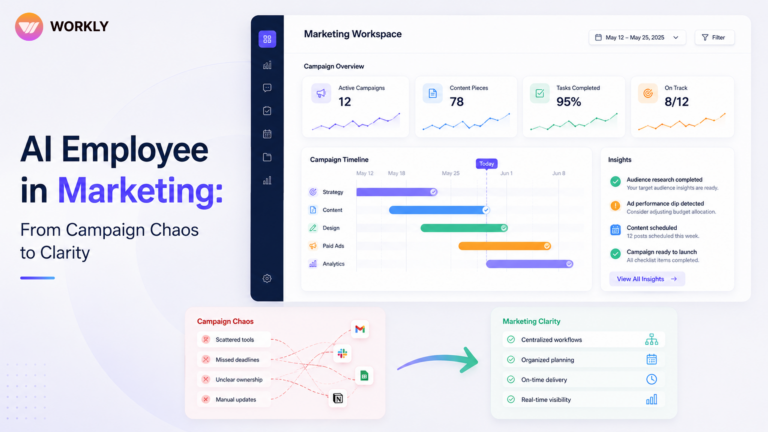
Campaigns are running. Content is going out. Ads are spending. But if you zoom out, most GTM efforts feel disconnected. Messaging changes across channels, personas are unclear, and campaigns don’t build on each other. You’re doing a lot—but not moving as one system.
These 10 prompts by Workly AI fix that. Choose our Marketing Specialist AI Employee and see how your GTM game changes within the first few weeks.
Launch chaos ends when prompts take control
They don’t just generate content. They force clarity. Each prompt acts like a strategic input you give your AI employee to produce structured, high-quality outputs—so your entire GTM motion starts working together instead of in silos.
- Full Go-To-Market Strategy
This prompt builds your entire GTM backbone. It aligns who you’re targeting, how you position, where you show up, and how you roll out—so every campaign has direction.
Prompt:
Create a Go-To-Market strategy for [Product Name], targeting [Target Audience] in the [Market/Region]. Our USP is [USP] and budget is [Budget].
- ICP to Buyer Personas
Instead of vague targeting, this prompt gives you detailed personas with real motivations and triggers—so your messaging actually resonates.
Prompt:
Analyze our ICP Ideal Customer Profile and generate 3 distinct buyer personas with their goals, fears, preferred channels, and buying triggers.
- Messaging Framework
This ensures consistency across all campaigns. No more mixed signals—every piece of content speaks the same language.
Prompt:
Write a messaging framework for our upcoming campaign including headline, value proposition, key differentiators, and a proof point for each.
- Content Gap Audit
Most teams create content without knowing what’s missing. This prompt identifies gaps across awareness, consideration, and decision stages—so you build a complete funnel.
Prompt:
Audit our current content strategy and identify gaps based on the buyer’s journey what content do we need for awareness, consideration, and decision stages.
- LinkedIn Content Calendar
Consistency builds trust. This prompt gives you a structured 30-day plan so you’re not posting randomly but building authority over time.
Prompt:
Generate a 30-day LinkedIn content calendar for our brand mix of thought leadership, product education, social proof, and engagement posts.
- Press Release Draft
A strong launch needs a clear story. This prompt turns your product update into something media-ready and impactful.
Prompt:
Draft a press release for our product launch that’s newsworthy, concise, and structured for media pickup.
- Paid Campaign Brief
Instead of running ads blindly, this prompt gives you a full blueprint—audience, messaging, and KPIs—so campaigns perform with intent.
Prompt:
Create a campaign brief for a paid ads campaign targeting mid-market HR leaders include audience targeting, ad copy variations, and KPIs.
- Re-Engagement Email Campaign
Cold leads aren’t dead—they’re just ignored. This prompt helps you bring them back with smarter subject lines and messaging.
Prompt:
Write 5 email subject lines and preview texts for a re-engagement campaign targeting leads who haven’t opened in 90 days.
- Competitor GTM Analysis
Instead of guessing your edge, this prompt shows where competitors are strong and where they’re weak—so you position smarter.
Prompt:
Summarize our competitor’s GTM strategy based on their website, case studies, and recent content where are the gaps we can exploit.
- Repurpose Customer Stories
Most teams underuse their best assets. This prompt turns one success story into multiple formats, maximizing reach without extra effort.
Prompt:
Turn our customer success stories into 3 different content formats: a case study, a LinkedIn post, and a 2-minute video script.
FAQ’S
What makes these prompts different from normal marketing prompts?
These aren’t random content generators. Each prompt is designed to solve a specific GTM problem—strategy, messaging, content, or execution—so outputs are structured and usable.
How should marketing teams use these prompts effectively?
Treat them like a workflow. Start with strategy prompts, then move to messaging, then execution. This ensures everything builds on the previous step.
Can these prompts replace a full marketing strategy?
They don’t replace thinking—they enhance it. They help you generate structured outputs faster, but decisions still come from your team.
Are these prompts useful for early-stage startups?
Yes. In fact, they help early teams build a GTM foundation quickly without needing large teams or external consultants.
What is the biggest shift after using these prompts?
Clarity and alignment. Instead of scattered efforts, your marketing starts operating like a system where every campaign connects and contributes to growth.
AI-First Collaborative OS
Stop managing tools. Start running work.


Emily Carter
Technical writer specializing in SaaS product documentation and in-app guides. Converts engineer-heavy inputs into clear user journeys, FAQs, and release notes.