Your remote team isn’t slow it’s stuck. Tasks wait, follow-ups pile up, and progress depends on who’s online. The real fix isn’t more meetings, it’s a system where work moves automatically.

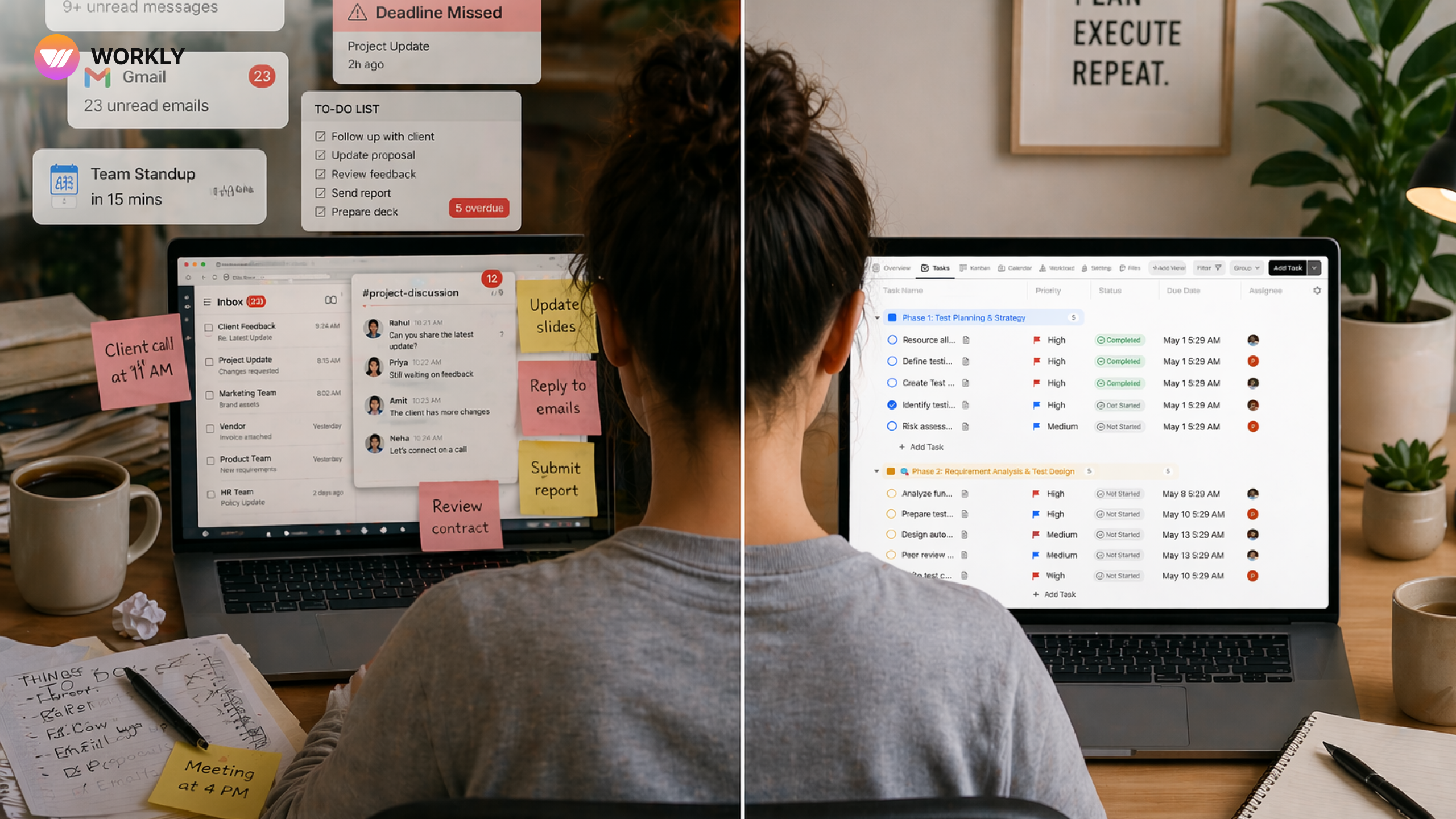
Remote work didn’t create chaos—it exposed it.
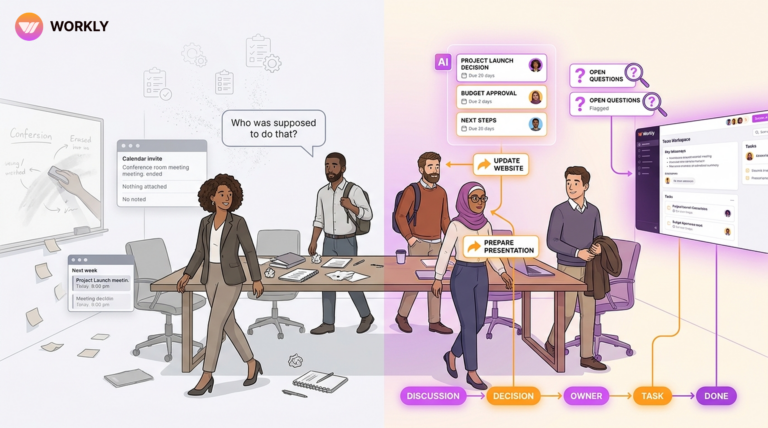
In offices, execution gaps were easy to hide. Someone would remind, follow up, or push things forward. In remote teams, those gaps turn into delays—tasks sit, ownership blurs, and progress depends on constant nudging.
So teams add more meetings.
But more communication doesn’t fix broken execution, it just adds noise.
The real problem?
Work doesn’t move unless someone pushes it.
Remote work breaks when execution depends on people
Execution Should Happen Even When No One Is Online
Most remote teams still operate like everyone is sitting together. Work only moves when someone assigns it, checks it, or reminds someone else. If that doesn’t happen, things stall.
Workly removes this dependency completely by turning execution into a self-moving system.
The AI Employee continuously monitors workflows and triggers actions in real time. When one task is completed, the next doesn’t wait for a human to assign it—it’s automatically activated. When a dependency is cleared, work progresses instantly. Even across time zones, execution doesn’t pause.
This changes the entire rhythm of remote work. Instead of progress happening in bursts during meetings or overlapping hours, work moves continuously in the background.
The result is simple but powerful:
Your team stops working in sync—and starts working in flow
Clarity Is Enforced, Not Assumed
One of the biggest silent killers of remote productivity is unclear tasks. When something is even slightly vague, it either gets delayed or done incorrectly, leading to rework.
Most teams assume clarity will happen through discussion. But in remote setups, discussion is delayed, fragmented, or skipped altogether.
Workly solves this by making clarity a system requirement, not a team habit.
Before any task enters execution, the AI Employee ensures it is fully actionable. It checks whether the objective is clear, ownership is defined, and necessary context is present. If something is missing, it flags it immediately instead of letting confusion flow downstream.
This prevents a common remote team pattern:
Starting fast → Getting stuck → Reworking later
Instead, work starts right—and stays on track.
Follow-Ups Are Automated, Not Chased
If you look closely at most remote teams, a surprising amount of time isn’t spent doing work—it’s spent chasing it.
“Any update?”
“Can you check this?”
“Waiting on your input”
This follow-up culture doesn’t just waste time—it slows execution at scale.
Workly eliminates this completely by shifting follow-ups from humans to the AI Employee.
The AI continuously tracks task movement. When something stalls, it doesn’t wait. It nudges the right person, highlights the delay, and escalates if needed. No one has to remember to check. No one has to manually follow up.
This creates a system where:
Work is always being pushed forward—even when people aren’t thinking about it.
And that’s where real productivity unlocks.
Visibility Without Interference
Managers in remote teams often feel stuck between two extremes—either constantly checking on work or having no idea what’s going on.
Workly introduces a different model: passive visibility with active execution.
At any point, managers can see the exact state of work—what’s progressing, what’s delayed, and where bottlenecks are forming. But unlike traditional tools, this visibility doesn’t demand action on every issue.
Because the AI Employee is already handling the movement.
It resolves minor delays, nudges stakeholders, and keeps workflows aligned automatically. Managers only step in when something genuinely needs decision-making.
This removes the pressure to micromanage while still maintaining full control over outcomes.
Consistency Becomes the Default, Not the Effort
Remote teams don’t usually fail in big ways. They fail in small, repeated inconsistencies.
A task is missed here.
A delay happens there.
A dependency breaks somewhere else.
Individually, these don’t seem critical. But over time, they compound into slow execution.
Workly fixes this by making workflows repeatable and enforced.
The AI Employee ensures that every process follows its defined path. Steps aren’t skipped. Dependencies aren’t ignored. Handoffs happen in sequence.
This creates something most remote teams lack:
predictability.
You’re no longer hoping things will move correctly.
You know they will.
What Changes When AI Starts Running the Work
When the AI Employee becomes the execution layer, the shift is immediate and measurable. Work no longer depends on memory, effort, or constant coordination—it moves because the system is designed to move it.
Turnaround time improves because tasks no longer sit idle between steps. The waiting time that used to exist between “done” and “what’s next” disappears entirely.
Follow-ups reduce drastically because the AI handles them automatically. Instead of team members spending time checking in, they focus entirely on execution.
Ownership becomes unambiguous. Every task has a clear owner, and the AI ensures accountability is maintained without manual intervention.
Delays are identified early, not after deadlines are missed. The system flags risks as they form, allowing teams to act before problems escalate.
Managers shift from tracking activity to observing outcomes. They no longer need to ask for updates because the system continuously reflects reality.
Most importantly, remote productivity becomes sustainable. It no longer depends on high effort, long hours, or constant communication—it’s built into how work flows.
The Real Shift: From Coordinating Work to Letting It Flow
Remote teams don’t need better communication habits.
They need better execution systems.
When:
- Tasks are clear from the start
- Work moves automatically
- Follow-ups are handled
- Delays are visible
Everything changes. You stop pushing work forward.
And work starts moving on its own.
That’s the difference between a team that feels busy
and a team that actually delivers.
FAQ’S
How do remote teams stay organized and productive?
By using structured workflows that allow tasks to progress automatically without relying on constant communication.
What are the best tools for managing remote teams and tasks?
Tools like Workly that combine remote team collaboration with workflow automation and AI-driven execution.
How does a sync work improve remote team efficiency?
It ensures work continues without waiting for meetings or real-time responses, increasing speed and consistency.
Can Workly reduce dependency on meetings?
Yes, because tasks move, update, and get tracked automatically without needing constant discussions.
What role does AI play in remote work execution?
AI ensures tasks move forward, follow-ups are handled, and delays are minimized without manual effort.
AI-First Collaborative OS
Stop managing tools. Start running work.


Rachel Nguyen!
Technical writer with a UX writing edge for enterprise products. Builds onboarding, contextual help, and knowledge bases that cut support tickets.